Commercial solar · PPA & lease · Georgia
Commercial solar that pencils out, before you sign anything.
Your tariff, your roof, your numbers.
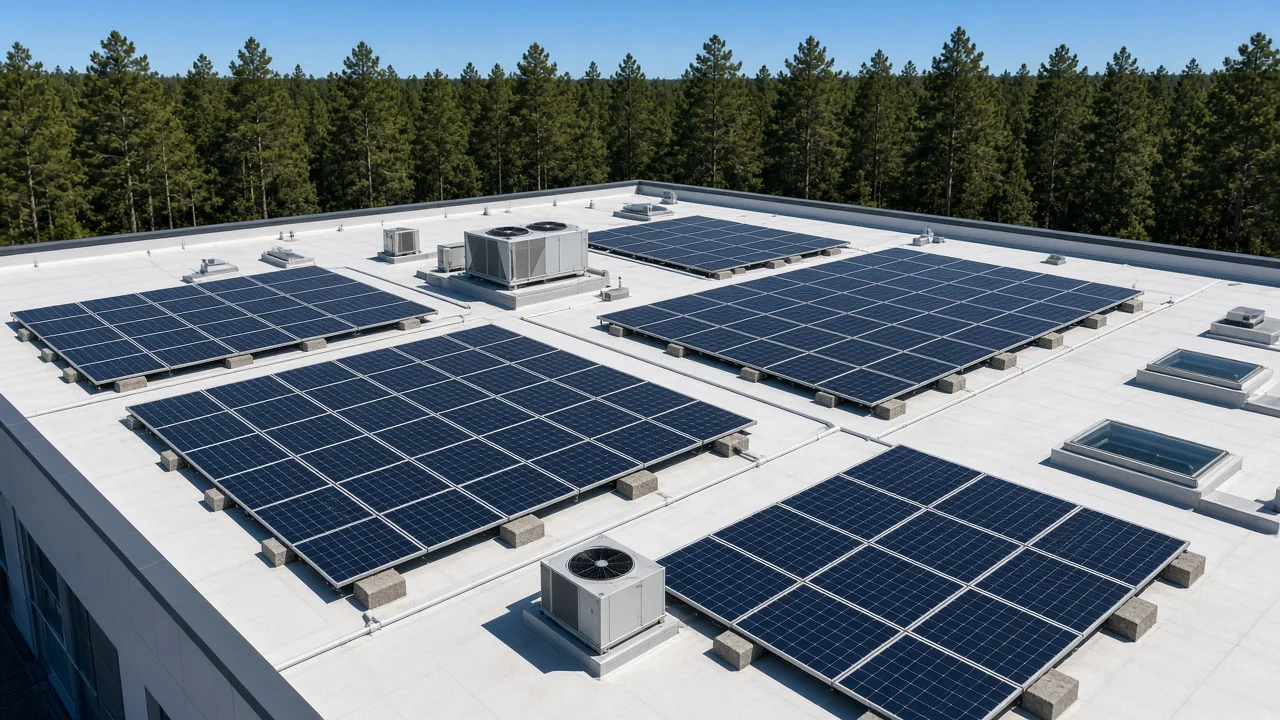
We're a commercial-only solar broker. We score your roof from satellite data and model the savings against your actual Georgia Power or EMC rate schedule. Then we line up PPA or lease options that fit the numbers, not the other way around.
Questions? Call 770-891-0291.
Our go / no-go promise
Commercial solar that pencils out, or we tell you it doesn't.
If the numbers don't work on your tariff, your roof and your load, we'll say so plainly before anyone asks you to sign. A clear "no" is a useful answer too.
Your tariff, not a national average.
Georgia Power's on-peak window is summer weekday afternoons, 2–7 PM. We show how much of your solar output actually lands there and value the rest at what it's really worth on your schedule.
Sized for the power you use, not the power you export.
Above 250 kW AC, exported solar earns roughly 3.3¢/kWh, so we size arrays to your own load. The savings show up on your bill, not the grid's.
The 2027 clock is real.
For projects starting now, the federal solar credit generally requires the system to be in service by Dec 31, 2027. Multi-MW roofs take time to design, permit and interconnect. A review now tells you whether the timeline is realistic. Projects may qualify depending on structure and eligibility; confirm with your tax advisor. (Status as of October 2026.)
How it works
Numbers first. Proposals second.
Score the roof
We estimate usable roof area and array size from satellite imagery and public building footprints. No site visit needed to start.
Match your tariff
We identify your utility and rate schedule (Georgia Power PLM, PLL or TOU, or your EMC's commercial rate) and confirm it against a recent bill.
Model hour by hour
Hourly production modeling (NREL PVWatts) is lined up against the hours your tariff actually charges the most. Systems are sized to what you use on site.
Compare PPA & lease
You get a plain-English picture of estimated savings and terms across PPA and lease structures before you commit to anything.
Who it's for
Big roofs, daytime loads.
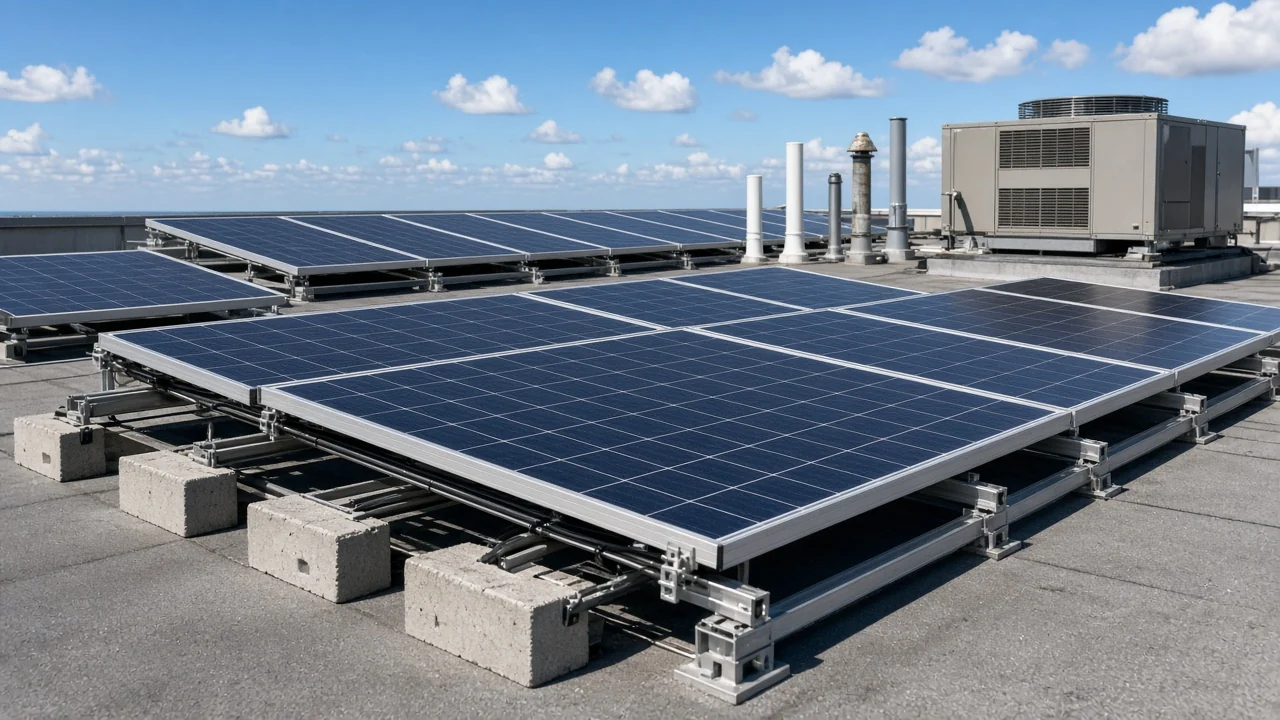
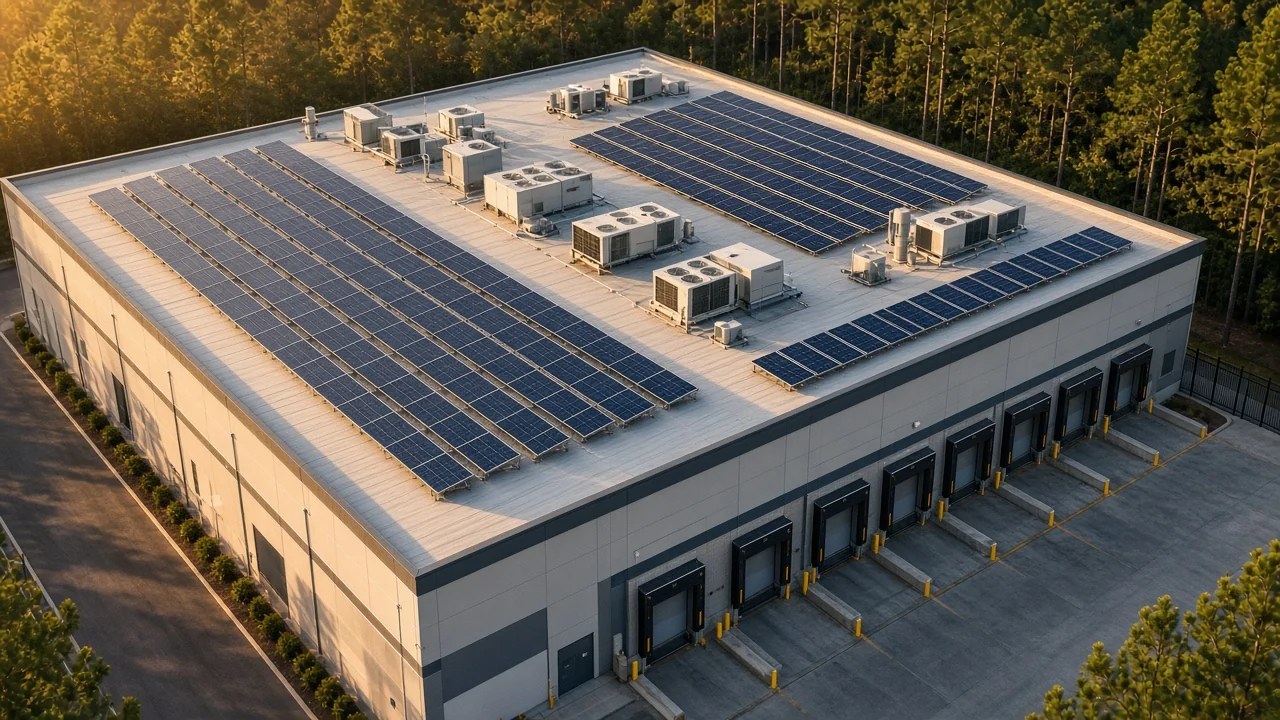
We work only with commercial and industrial buildings, typically 30,000 sq ft or larger, in West Georgia: Carrollton, Newnan, Peachtree City and surrounding counties.
- Warehouses & distribution
- Manufacturing
- Cold storage & food processing
- Auto service & dealerships
- 30k+ sq ft
Refrigeration and weekday process loads tend to line up best with solar output. Large ambient warehouses have the roof but often not the daytime load. We'll tell you which one you are.
What we are: an independent broker and analyst.
What we're not: an installer, a utility, or a lender. We don't sell residential solar.
Projects may qualify for federal tax incentives depending on timing, structure and eligibility. Confirm with your own tax advisor.
The tariff angle, explained honestly
When you use the power matters as much as how much you make.
- On-peak is narrow. On Georgia Power's commercial time-of-use schedules, on-peak is June through September, weekdays, 2–7 PM. Most solar production falls outside that window, so it's valued at lower shoulder and off-peak prices.
- Size to self-consumption. Georgia Power's renewable rider credits exports at a higher rate only for commercial systems up to 250 kW AC. Above that, exported power earns roughly the utility's solar avoided cost, about 3.3¢/kWh. Power you use on site is worth far more than power you send back.
- Demand charges are uncertain. Clouds don't respect billing intervals. We don't count demand-charge savings unless your load data supports it.
- EMCs are different. Carroll EMC, Coweta-Fayette EMC and others have their own commercial rates and interconnection rules. Service territories overlap in parts of West Georgia, so we confirm your actual supplier from your bill.
Why this matters for a PPA or lease: the right price per kWh depends on which of your kWh the system displaces. A proposal modeled against a flat average rate can look better than your bill will.
Rate references: Georgia Power TOU-GSD, PLM, PLL and RNR tariff sheets and Carroll EMC GS-4, as published by each utility. Rates change; we re-check them on every analysis.
Scored buildings
25 West Georgia roofs we've already scored
Scores (1–10) combine estimated system size, how well the building's use matches solar hours, likely ownership, and utility certainty. Savings are tariff-based: estimated energy savings per year on the applicable commercial time-of-use rate, not a flat rate.
| # | Building type | Score | Est. savings/yr |
|---|---|---|---|
| 1 | Vehicle manufacturer 2 buildingsNewnan · 3.7 MW | 9.2 | $456k |
| 2 | Meat processing plantNewnan · 1.1 MW | 8.9 | $129k |
| 3 | Wire & cable manufacturer (main campus) 6 buildingsHas planned/existing on-site solarCarrollton · 18.2 MW | 8.6 | $2.2M |
| 4 | Aluminum extrusion plantNewnan · 4.5 MW | 8.6 | $543k |
| 5 | Fiber-optic cable manufacturerCarrollton · 3.9 MW | 8.6 | $470k |
| 6 | Commercial hardware manufacturerNewnan · 2.2 MW | 8.6 | $266k |
| 7 | Beverage bottling plantNewnan · 4.4 MW | 8.3 | $534k |
| 8 | Paper products converterCarrollton · 1.7 MW | 8.1 | $206k |
| 9 | Seafood processing & cold storageCarrollton · 1.5 MW | 8.1 | $184k |
| 10 | Building products manufacturerNewnan · 1.0 MW | 8.1 | $121k |
| 11 | Auto parts manufacturer 2 buildingsCarrollton · 5.3 MW | 7.8 | $633k |
| 12 | Appliance components manufacturerNewnan · 1.4 MW | 7.5 | $176k |
| 13 | Beef processing plantCarrollton · 1.2 MW | 7.5 | $144k |
| 14 | Retail distribution centerCarrollton · 7.2 MW | 7.2 | $858k |
| 15 | Foodservice distribution centerNewnan · 1.8 MW | 7.2 | $219k |
| 16 | Auto parts manufacturerCarrollton · 1.6 MW | 7.2 | $194k |
| 17 | Industrial manufacturerCarrollton · 1.5 MW | 7.2 | $184k |
| 18 | Temperature-controlled distribution centerNewnan · 1.2 MW | 7.2 | $143k |
| 19 | Retail distribution centerNewnan · 7.2 MW | 6.9 | $878k |
| 20 | Third-party logistics warehouseNewnan · 7.2 MW | 6.9 | $878k |
| 21 | Heavy equipment manufacturerPeachtree City · 3.6 MW | 6.9 | $457k |
| 22 | Technology company facilityPeachtree City · 3.2 MW | 6.9 | $402k |
| 23 | Packaging manufacturerNewnan · 2.3 MW | 6.9 | $283k |
| 24 | Industrial manufacturerNewnan · 2.1 MW | 6.9 | $260k |
| 25 | Powertrain components manufacturerNewnan · 1.9 MW | 6.9 | $237k |
System size = estimated DC capacity from roof footprint (capped per building), shown in MW. Savings = estimated year-one energy savings, assuming most output is used on site. Demand-charge effects are excluded. Multi-building sites are combined. Data: buildings.json.
Run the numbers
What would a financed system look like each month?
Pick a scored building, or choose Your building and enter your own system size. Every input is an adjustable assumption. This models an owned, loan-financed system. PPA and lease pricing are quoted separately by providers.
Enter your current monthly bill to see a before-and-after comparison.
Estimates only. Year-1 figures. No escalation, degradation, depreciation or taxes beyond the optional ITC toggle. Demand charges are not modeled, and fixed customer charges stay on your bill. Savings depend on your actual tariff, load and system design. This isn't an offer of financing, and the rates shown aren't quotes.
Before you sign
Already have a solar proposal? Get a free second opinion.
Send us the proposal you've been offered. We'll check it against your actual rate schedule and load:
- Is production valued at your real tariff periods, or at a flat average rate?
- Is the system sized to on-site use, or will a large share export at about 3.3¢/kWh?
- What do the escalator, term, minimums, buyout and removal terms do over the full contract?
- Does the timeline realistically meet the Dec 31, 2027 in-service requirement, if the incentive matters to the deal?
What to have ready: the proposal, 12 months of utility bills (interval data if you have it), your building address, and whether you own or lease the building.
No obligation. If the proposal you have is a good one, we'll tell you that too.
Call 770-891-0291 to send it over.
Straight answers
Common objections
What happens to our roof warranty?
That's the first thing to settle. Before any agreement, the roof's age, condition and warranty terms should be reviewed, and the installer's work should be coordinated with your roofing manufacturer or contractor so the warranty is preserved. If the roof will need replacing during the solar contract term, it usually makes sense to re-roof first. We flag this in every review.
What if we sell the building?
Third-party agreements normally address this directly, through assignment to the new owner, a buyout option, or relocation and removal terms. These clauses differ a lot between providers. We read them before you sign, not after.
What if the solar provider goes out of business?
On a PPA or lease, the system is owned by a third party, so the provider's strength matters. Look at who owns and finances the system, who is responsible for operations and maintenance, and whether the agreement can be assigned to a successor owner. We review the counterparty and those terms as part of the analysis.
How do solar PPAs work in Georgia?
In Georgia, an on-site third-party agreement is known as a solar energy procurement agreement (SEPA), permitted under the state's Solar Power Free-Market Financing Act of 2015 (O.C.G.A. § 46-3-60 et seq.). For non-residential customers, a SEPA system is capped at 125% of the building's actual or expected peak demand, and the utility must get at least 30 days' notice before it operates. A provider owns the system on your roof and you pay for the power it produces (PPA) or pay a fixed amount for the equipment (lease). You remain a customer of Georgia Power or your EMC for everything the system doesn't cover, and interconnection goes through your utility.
Why not build the biggest system the roof can hold?
Because exported power is worth much less than power you use. Georgia Power's renewable rider gives an export adder only to commercial systems up to 250 kW AC. Larger systems' exports earn roughly the utility's solar avoided cost, about 3.3¢/kWh. Big systems can also need more extensive interconnection studies. Sizing to on-site load is usually what makes the numbers work.
We lease our building. Can we still do this?
Possibly, but the landlord controls the roof. Roof-use rights, lease term and who benefits from the savings all need to be agreed in writing. We check ownership on every building we score and flag tenant situations up front.
We're on an EMC, not Georgia Power. Does this apply?
Yes, but the math is different. Each EMC has its own commercial rates, buy-back terms and interconnection rules. Service territories overlap in parts of West Georgia, so we confirm your supplier and schedule from your bill before modeling anything.
How do you get paid?
Our fee terms will be disclosed in writing before any engagement begins. You'll know who pays us, and how much, before you rely on our analysis.
Ready to see if your roof pencils out?
Trace your roof for an instant estimate, request a free savings check, or call us. If the numbers don't work on your tariff, we'll tell you.